
Granulation Systems




A production line can appear healthy during a walk-through and still be moving toward an avoidable shutdown. Melt pressure may drift gradually, the drive may run warmer than usual, or a screen changer may require more frequent attention. When output targets are tight and feedstock includes recycled content or variable formulations, these small changes can quickly become scrap, unstable dimensions, excess energy use, or a stopped line.
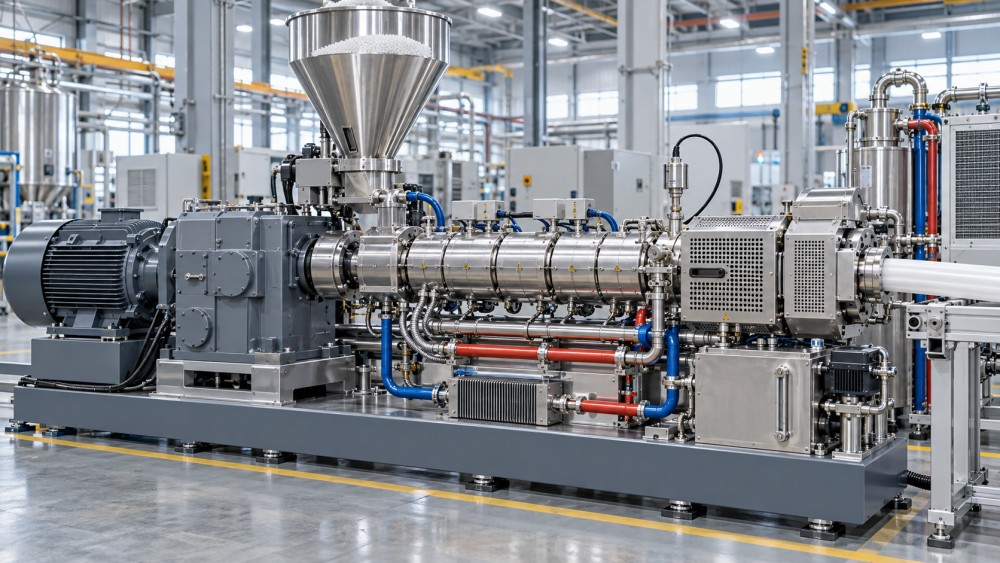
What maintenance plan suits extrusion machinery? For most operations, the best choice is a layered plan: operator-led routine checks, calendar-based preventive service for wear items, condition-based inspection for critical components, and predictive monitoring where a failure would be expensive or difficult to detect early. No single approach is sufficient. A purely time-based schedule can replace usable parts too early, while a run-to-failure approach often turns a manageable repair into damage to screws, barrels, gearboxes, or downstream equipment.
Why extrusion lines need a mixed maintenance approach
Extrusion machinery operates as a connected system. Material preparation, feeding, heating, melting, conveying, filtration, die performance, cooling, haul-off, and controls all influence one another. A fault in one area may first show up somewhere else. For example, higher melt pressure may indicate screen blockage, but it may also be related to material contamination, a colder-than-expected barrel zone, poor feeding consistency, or die restriction.
This is why the maintenance plan should not be built around isolated machines alone. It should consider the line’s failure consequences, process sensitivity, material mix, operating hours, and the practical ability to observe condition changes. A small auxiliary fan may be inexpensive and simple to replace after failure. A gearbox, main motor, barrel, or precision die requires much earlier warning because its failure can stop production and create a longer recovery period.
Operations processing stable virgin resin on predictable shifts can rely more heavily on scheduled preventive work. Lines running high recycled content, abrasive fillers, moisture-sensitive polymers, or frequent product changes need more condition checks because wear and contamination patterns are less predictable. The plan should reflect that difference rather than applying the same interval to every extruder.
Comparing the main maintenance models
Reactive maintenance still has a place, but it should be deliberate. Light bulbs, non-critical guards, minor external fittings, and readily available low-cost parts may reasonably be handled after failure. It is a poor strategy for the main drive, gearbox lubrication system, barrel heating and cooling circuits, vacuum equipment, or safety-related controls.
Preventive maintenance remains the foundation for extrusion lines because many tasks have established intervals. Lubricant changes, electrical enclosure cleaning, terminal checks, filter servicing, belt inspection, cooling-water checks, and die cleaning are examples. These tasks reduce routine degradation, but their intervals should be reviewed against actual operating conditions. A line in a dusty environment or one running around the clock may need more frequent attention than the original generic schedule suggests.
Condition-based maintenance adds the process context that a calendar cannot provide. Instead of replacing a screw simply because it has operated for a certain number of hours, the maintenance team measures wear, monitors throughput stability, compares melt pressure behavior, and inspects product quality. This approach is especially useful when processing materials that accelerate wear or leave deposits.
Predictive maintenance is most valuable where gradual mechanical or thermal changes precede failure. Trending gearbox vibration, bearing temperature, motor load, cooling performance, and pressure behavior can reveal a developing issue before it becomes an emergency. It does not mean every line needs a complex monitoring system. Even consistent manual readings, recorded at the same conditions, can serve as practical predictive data when the history is reviewed rather than merely filed away.
Build the plan around failure impact, not around a generic checklist
Start by separating equipment into three groups: production-critical assets, quality-critical assets, and lower-consequence support items. Some components belong in more than one group. A melt-pressure sensor may not stop the extruder mechanically, yet unreliable readings can lead to poor process decisions and off-spec output. A cooling pump can affect dimensional stability long before it causes an obvious alarm.
For each item, identify four points: what failure looks like, how quickly it develops, what signal can reveal it, and what happens if action is delayed. This creates a useful basis for choosing the maintenance method.
- Use scheduled preventive work where deterioration is predictable or the task is simple and low-risk, such as lubrication, cleaning, tightening, and replacement of consumables.
- Use condition checks where wear depends on material, load, contamination, or operating temperature, such as screws, barrels, filters, feeders, cooling circuits, and dies.
- Use predictive monitoring where a developing fault has measurable signals and the cost of unexpected failure is high, including gearboxes, motors, bearings, and major cooling or vacuum equipment.
- Allow controlled reactive repair only where failure will not compromise personnel safety, cause major quality loss, or create collateral equipment damage.
Do not classify components only by replacement cost. A relatively inexpensive thermocouple can have a large operational consequence if it causes an incorrect barrel-temperature reading. Likewise, a heater band may be simple to replace, but repeated heater failures can point to poor contact, wiring damage, inadequate cooling, or incorrect control tuning. The plan should require the team to address recurring causes, not only replace the failed part.
What routine work should happen during normal operation
The most effective inspection tasks are short enough to be completed consistently and specific enough to reveal change. Operators are often the first people to notice a new noise, unstable pressure, pellet feed bridging, unusual odor, water leakage, or a shift in product appearance. Their observations should feed into maintenance decisions through a simple log, not remain informal handover comments.
At shift level
Record actual barrel and die temperatures, melt pressure, motor load, output rate, cooling-water status, and any abnormal alarms. These values matter most when compared under similar recipes and operating conditions. A single reading outside the normal range may be caused by a product change; a steady trend across comparable runs deserves investigation.
Inspect for leaks around hydraulic, pneumatic, coolant, and lubrication connections. Check that hopper loaders, feeders, dryers, and magnets are clean and functioning as expected. Look at guards, emergency-stop access, and visible wiring condition. Product observations are also part of maintenance: surging, black specks, gel formation, surface roughness, dimensional drift, or frequent die buildup can be early evidence of equipment or process deterioration.
At weekly or planned intervals
Review screens and filtration behavior, especially when recycled material is used. An increase in screen-change frequency may indicate contamination upstream, but it may also reveal a change in supplier consistency, grinding practice, or storage control. Inspect cooling fans, pumps, hoses, and heat-exchanger surfaces; restricted cooling often appears as unstable temperature control rather than an immediate shutdown.
Verify that heaters, thermocouples, pressure sensors, and control loops respond plausibly. Electrical panels need cleaning and inspection appropriate to their environment, because dust, loose terminals, and heat buildup can shorten component life. Check gearbox oil level and inspect for unusual discoloration, odor, or leakage. The exact oil-analysis program should match gearbox criticality and the lubricant supplier’s recommendations.
Condition signals that should change the maintenance priority
A good plan allows inspection frequency to increase when the process gives a warning. This is particularly important after a material change, a die change, an upset involving overheating, or a period of unstable feeding. Treat these events as triggers for targeted checks rather than waiting for the next standard service date.
Increasing motor current at the same throughput can indicate higher melt resistance, mechanical drag, material variation, or a developing drive problem. Pressure fluctuations may point to feed inconsistency, screw wear, temperature instability, contamination, or restrictions in the screen pack and die. A rising difference between commanded and actual temperature can suggest heater weakness, cooling-valve issues, poor sensor contact, or tuning problems.
Mechanical signals also deserve attention. New vibration, a change in gearbox noise, elevated bearing temperature, recurring coupling misalignment, or excessive lubricant contamination should move the affected equipment from routine observation to planned diagnostic work. Running until the noise becomes severe is rarely efficient, because damage can spread from a bearing or coupling to shafts, housings, and the drive train.
Special considerations for screws, barrels, and dies
The screw and barrel are central to extrusion performance, yet they are often assessed only after output or quality has already declined. Wear changes the geometry that controls conveying, melting, pressure development, mixing, and residence time. The effect depends on resin, filler content, operating temperature, screw design, and the process demands of the product.
Schedule dimensional inspection when there is evidence of persistent output loss, unstable melt pressure, increased power demand, poor melt homogeneity, or a known abrasive material history. Inspection should include the areas most exposed to wear rather than relying only on a visual check at accessible ends. Measurements need to be compared with the equipment maker’s tolerances and the process requirements; a component may still be mechanically usable while no longer capable of producing stable, quality-critical output.
Die maintenance should be tied to product requirements and material behavior. Deposits, corrosion, damage at flow surfaces, blocked channels, and poor surface finish can create defects that resemble upstream process problems. Cleaning methods must suit the die material and polymer residue. Aggressive mechanical cleaning can damage precision surfaces, so the procedure should define approved tools, handling methods, and storage conditions after cleaning.
Turning collected data into a practical schedule
Maintenance records become useful when they connect equipment condition with process conditions. A work order that only says “replaced heater” provides little help later. A better record notes the affected zone, symptoms, measured values, material being processed, inspection findings, corrective action, and whether the issue recurred. Over time, this reveals whether a component is failing randomly or whether an underlying pattern exists.
Keep the schedule adaptable. When a line moves from virgin resin to higher recycled content, increases operating hours, changes a formulation, or begins producing tighter-tolerance profiles or film, revisit inspection intervals and alarm limits. Conversely, if repeated records show that an interval is unnecessarily conservative and component condition remains stable, the team can adjust it carefully rather than servicing by habit.
The right plan is therefore not “preventive versus predictive.” It is preventive work for known routine needs, condition-based decisions for wear and process-sensitive equipment, and predictive monitoring for critical assets that give measurable early warnings. That combination protects uptime without treating every component as equally urgent, and it gives maintenance teams a clearer reason to act before extrusion performance is affected.
Related News
- 00
0000-00
Metal Shaping Methods: Selecting Processes by Alloy, Tolerance, and Production Volume - 00
0000-00
How to Compare Control System Platforms for Integration, Lifecycle Cost, and Support - 00
0000-00
Root-Cause Analysis of Precision Molding Defects: From Flash to Dimensional Drift - 00
0000-00
CE Marking for Automated Grippers: Safety Requirements and Technical File Essentials - 00
0000-00
How to Evaluate a Material Forming Equipment Factory Before Placing an Order
Weekly Insights
Stay ahead with our curated technology reports delivered every Monday.