
Giga-Casting




Do New Energy Vehicle Parts Require Giga-Casting?
Do new energy vehicle parts require giga-casting? No. Giga-casting is a valuable manufacturing route for selected structural parts, but it is not automatically the best choice.
For EV manufacturers, the central question is whether a large integrated casting improves total vehicle economics, performance, and production resilience compared with assembled alternatives.
The answer depends on vehicle architecture, annual volume, alloy strategy, factory capability, repair policy, and the company’s ability to control quality at scale.
Giga-casting can reduce part count, simplify body assembly, and support lightweighting. However, it also concentrates technical risk inside a high-value component and production cell.
Automotive decision-makers should therefore assess giga-casting as an operating-system choice, rather than treating it as a fashionable replacement for conventional body manufacturing.
This article explains where giga-casting creates measurable value, where conventional processes remain stronger, and how NEV manufacturers can make an informed investment decision.
Why Giga-Casting Is Important for New Energy Vehicle Structures
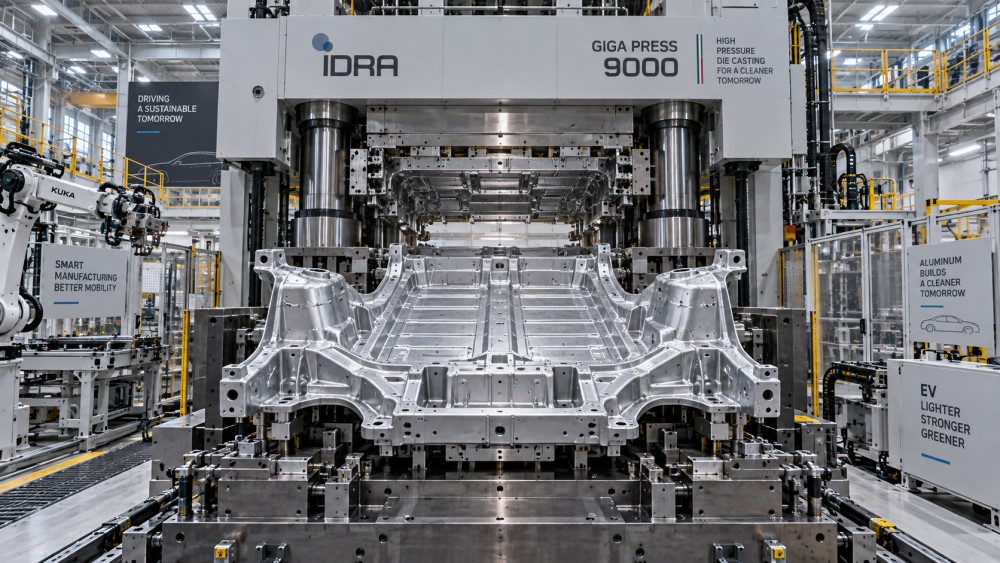
Giga-casting refers to high-pressure die-casting processes that produce unusually large aluminum structural components using machines with extremely high locking-force capacity.
In new energy vehicles, these castings are commonly considered for rear underbodies, front compartments, battery-related structures, suspension mounting zones, and floor-adjacent components.
The technology became strategically relevant because electric vehicles need strong crash structures while carrying heavy battery packs and meeting aggressive cost-reduction targets.
Traditional vehicle bodies often contain dozens of stamped, extruded, or cast components joined through welding, riveting, bonding, and fastening operations.
Replacing multiple components with one integrated casting can eliminate joining steps, reduce fixtures, shorten material flow, and decrease body-shop complexity.
For manufacturers building high-volume EV platforms, these reductions can improve takt time and reduce the number of process variables affecting dimensional consistency.
Integrated castings may also create packaging freedom. Designers can place ribs, attachment points, channels, and reinforcement features directly into the component geometry.
That freedom is useful only when engineering teams consider casting limitations early. A complex geometry that cannot fill, vent, cool, or eject reliably has little production value.
Which NEV Parts Benefit Most from Giga-Casting?
Rear underbody assemblies are the most widely discussed giga-casting application because they often contain many brackets, rails, cross-members, and suspension interfaces.
A conventional rear structure may require numerous stampings and joining stations. A large casting can consolidate these interfaces into a single load-bearing architecture.
Front-end structures can also be suitable when they combine crash-management, suspension, steering, and powertrain mounting requirements within a carefully engineered casting envelope.
Battery-adjacent components are more selective. They must satisfy stiffness, sealing, thermal, crash, corrosion, and serviceability requirements, which may favor hybrid structures instead.
Giga-casting is generally less appropriate for exterior panels, highly cosmetic surfaces, low-load trim, interior components, or parts requiring frequent model-specific changes.
Small brackets and precision housings may remain better candidates for conventional die-casting, machining, stamping, injection molding, extrusion, or assembled multi-material solutions.
The strongest application candidates combine several conditions: high annual production volume, substantial joining complexity, stable geometry, meaningful mass-saving potential, and repeatable structural loads.
Parts with uncertain demand, short program lives, frequent engineering revisions, or complex repair requirements should receive much more conservative economic evaluation.
What Business Value Can Giga-Casting Deliver?
The main commercial benefit is not simply a lower component count. It is the possibility of redesigning the complete manufacturing chain around fewer structural interfaces.
Fewer pieces can reduce supplier coordination, inbound logistics, storage space, fixture demand, weld inspection, operator requirements, and body-shop floor-space consumption.
When consolidation is successful, the manufacturer may improve dimensional accuracy by removing tolerance accumulation across multiple joining and locating operations.
Vehicle mass may decrease when engineers remove overlapping flanges, redundant reinforcements, fasteners, and joints that were necessary in a multi-part construction.
Weight reduction can help compensate for battery mass, improve energy efficiency, support range targets, and potentially allow optimization of other vehicle systems.
Cycle-time improvements are another attraction. A casting cell can replace portions of stamping, joining, and inspection work, although casting itself introduces new control demands.
Capital efficiency should be evaluated across the entire body system. The relevant comparison is not one die-casting machine against one stamping press.
Management teams should compare tooling, automation, buildings, utilities, scrap handling, machining, joining equipment, quality systems, maintenance, and launch-risk costs over the program lifecycle.
What Technical Constraints Must Manufacturers Address?
Large castings are unforgiving because melt quality, die temperature, filling behavior, vacuum performance, cooling balance, and machine control all influence final component integrity.
Porosity remains a central concern. Gas entrapment and shrinkage defects can reduce mechanical performance, complicate joining, and create inconsistent results during crash loading.
Advanced vacuum die-casting, melt treatment, thermal management, and real-time process monitoring are essential when structural castings require demanding elongation and fatigue performance.
Alloy selection also matters. Engineers must balance castability, corrosion resistance, strength, ductility, heat-treatment compatibility, recyclability, and joining behavior.
Some casting alloys offer strong production performance but limited post-casting heat-treatment flexibility. Others offer different mechanical advantages while increasing process sensitivity or cost.
Die life can become a substantial operating issue. Large dies experience significant thermal cycling, local wear, erosion, soldering, and maintenance requirements.
Cooling-channel design, die steel selection, surface treatment, lubrication strategy, and predictive maintenance directly affect casting quality, uptime, and tooling economics.
Giga-casting therefore requires an integrated engineering model. Product designers, alloy specialists, die engineers, automation teams, quality leaders, and plant operators must collaborate from concept development.
How Do Repairability and Insurance Change the Decision?
Repairability is one of the most important concerns surrounding large integrated castings. Damage that affects a localized zone can sometimes require replacement of a much larger structure.
This can raise repair costs, increase parts logistics complexity, and influence vehicle residual value, insurance pricing, collision-center procedures, and customer experience.
However, repair outcomes depend on design details rather than casting size alone. Manufacturers can define cut lines, replaceable crash sections, repair procedures, and approved joining methods.
Modular sacrificial elements can protect expensive cast structures during low-speed impacts. This strategy may preserve the benefits of integration while reducing common collision repair exposure.
OEMs should engage repair networks and insurers during development. A technically elegant casting design can create commercial friction if it lacks validated repair instructions.
Crash performance must also be evaluated across realistic damage scenarios. Structural continuity is beneficial, but controlled deformation and load paths must remain predictable after impact.
Service teams need access to diagnostic data, replacement guidance, torque specifications, joining instructions, and training that reflect the new vehicle construction method.
A giga-casting program should include total cost of ownership analysis. Factory savings alone do not establish value if downstream repair costs materially harm brand economics.
What Does Giga-Casting Mean for Circular Manufacturing?
Aluminum is attractive for circular manufacturing because production scrap and end-of-life material can be collected, sorted, remelted, and reused within managed alloy systems.
Yet circularity is not automatic. Recycled content must meet composition requirements, and contamination from coatings, inserts, mixed alloys, and foreign materials requires disciplined control.
Large castings can generate meaningful internal scrap flows during launch, trimming, machining, and defect handling. Closed-loop recycling plans should be established before volume production begins.
Material traceability is particularly important for structural components. Manufacturers need visibility into melt chemistry, recycled-content sources, process history, and quality outcomes.
Designing for recycling means reducing unnecessary material combinations and considering how inserts, steel attachments, coatings, and fasteners will be separated at end of life.
Lifecycle carbon performance also depends on electricity sources, aluminum supply, melt efficiency, transportation, yield rates, and the avoided energy associated with eliminated joining operations.
For this reason, a giga-casting sustainability claim should be supported by a lifecycle assessment rather than relying only on lower part counts or lightweighting assumptions.
Companies that combine high-yield casting, recycled aluminum management, renewable energy procurement, and durable product design can create a more defensible circular manufacturing advantage.
How Should an NEV Manufacturer Decide Whether to Use Giga-Casting?
Start with architecture, not equipment. Identify where existing assemblies create excessive joining complexity, tolerance problems, unnecessary weight, cost pressure, or factory bottlenecks.
Next, calculate the true part-consolidation opportunity. Count eliminated components, processes, fixtures, inspections, material movements, suppliers, and quality failure points.
Then assess annual volume and program stability. Large casting tools and equipment require sufficient utilization and a design mature enough to justify specialized investment.
Evaluate the structure using simulation and physical validation. Include static stiffness, fatigue, corrosion, noise behavior, crash performance, thermal effects, and manufacturing variation.
Manufacturing feasibility should be tested through filling simulation, thermal studies, vacuum strategy, gating design, die maintenance planning, and automation-cycle analysis.
Financial models should include launch scrap, ramp-up losses, downtime exposure, spare-part inventory, machine redundancy, repair costs, and the cost of qualified technical personnel.
Supply-chain resilience deserves equal attention. A giga-casting line depends on reliable access to alloys, dies, high-capacity machines, maintenance support, process data, and skilled operators.
The best decision may be a hybrid approach. Some vehicle zones can use integrated castings, while others remain stamped, extruded, bonded, or mechanically joined for flexibility.
Conclusion: Giga-Casting Is a Selective EV Manufacturing Tool
Do new energy vehicle parts require giga-casting? They do not. Giga-casting is most effective when it solves a specific structural, operational, and economic problem.
Its strongest use cases involve high-volume, structurally integrated vehicle zones where part consolidation can improve cost, weight, accuracy, and production efficiency simultaneously.
Its main risks involve process control, tooling durability, repairability, capital concentration, supply resilience, and recycling discipline. These issues require early cross-functional planning.
For NEV manufacturers, the practical objective is not to maximize casting size. It is to select the manufacturing architecture that delivers the best lifecycle value.
Related News
- 00
0000-00
How to Evaluate a Material Forming Equipment Factory Before Placing an Order - 00
0000-00
How to Specify Cleanroom Equipment for Semiconductor Manufacturing Lines - 00
0000-00
What Drives Material Shaping Technology Cost in High-Volume Manufacturing? - 00
0000-00
ISO Compliance for Precision Molded Components: What Quality Teams Must Verify - 00
0000-00
What Drives Precision Material Shaping Cost in High-Volume Production Projects?
Weekly Insights
Stay ahead with our curated technology reports delivered every Monday.