
Commercial Insights




Lightweight manufacturing is worth the tooling cost when the weight reduction survives the full production and use cycle: the part still meets stiffness, durability, dimensional, assembly, and recycling requirements while lowering material consumption, handling burden, or downstream system cost. It is not automatically justified by using a lighter alloy or thinner wall. The economics turn on production volume, part geometry, joining strategy, material behavior, and the amount of process control needed to keep variation within tolerance.
A heavier component made with a stable, mature tool can remain the better commercial choice when volumes are limited, the component is not weight-sensitive, or lightweighting introduces scrap, secondary operations, and validation work that absorb the expected material savings. By contrast, a high-volume molded or cast component can justify substantial tooling investment when an improved design removes mass repeatedly, shortens cycle time, eliminates assemblies, or enables a smaller adjacent component.
Tooling cost is only one part of the investment
The visible cost is the mold, die, fixture, trim tool, or handling equipment. The less visible portion often determines whether the project performs as expected: mold-flow or fill analysis, material trials, cooling design, gating changes, measurement fixtures, robot end effectors, quality validation, and process development. A lightweight part is commonly less tolerant of process drift because there is less material available to absorb local stress, incomplete fill, uneven cooling, or dimensional distortion.
For injection molding, reducing wall thickness often requires a different balance of melt temperature, injection speed, gate size, venting, and cooling capacity. A tool designed for a conventional wall section may fill a thinner geometry only at pressures that increase flash risk, clamp demand, or residual stress. Raising pressure alone is rarely a durable answer. The flow path, gate location, weld-line position, rib arrangement, and material viscosity must support the new geometry together.
Die-cast lightweighting has a similar pattern. A thinner aluminum or magnesium section can reduce part mass, but it may become more sensitive to air entrapment, thermal imbalance, filling velocity, and localized porosity. Where the casting will be machined, joined, coated, or heat treated, the acceptable internal quality level may be tighter than a simple visual inspection suggests. A lower-mass casting that requires extensive rework or rejects is not truly material-efficient.
The correct comparison is therefore between two capable production systems, rather than between the purchase price of a new tool and the material bill of an old part. A durable business case includes the present tool's maintenance burden, yield, cycle time, assembly content, and operational constraints as well as the new tool's cost.
Where lightweighting creates real value
The strongest cases usually involve more than a small reduction in resin or metal. A redesigned component may consolidate brackets, fasteners, or reinforcement pieces into one molded structure. It may reduce the load carried by a moving mechanism, allowing smaller motors, bearings, counterweights, or support members elsewhere. In transport-related equipment, lower mass can influence energy use during operation; in handheld products, it can improve handling without changing the basic function.
Material savings are also more meaningful when the removed mass is expensive, difficult to transport, or exposed to volatile supply conditions. However, material price alone should not decide the project. Replacing a thick commodity polymer part with a thinner reinforced polymer can increase unit material cost even while part mass declines. The change earns its place only if stiffness, creep resistance, impact behavior, surface requirements, and manufacturability are maintained at the intended service temperature and load condition.
A useful distinction is between mass removal and structural efficiency. Mass removal simply makes a wall thinner. Structural efficiency redistributes material into ribs, corrugations, closed sections, strategic bosses, or load paths that preserve the function with less total material. The second approach often needs more sophisticated tooling, but it is less likely to create a part that passes a short test yet warps, cracks, or loosens after repeated use.
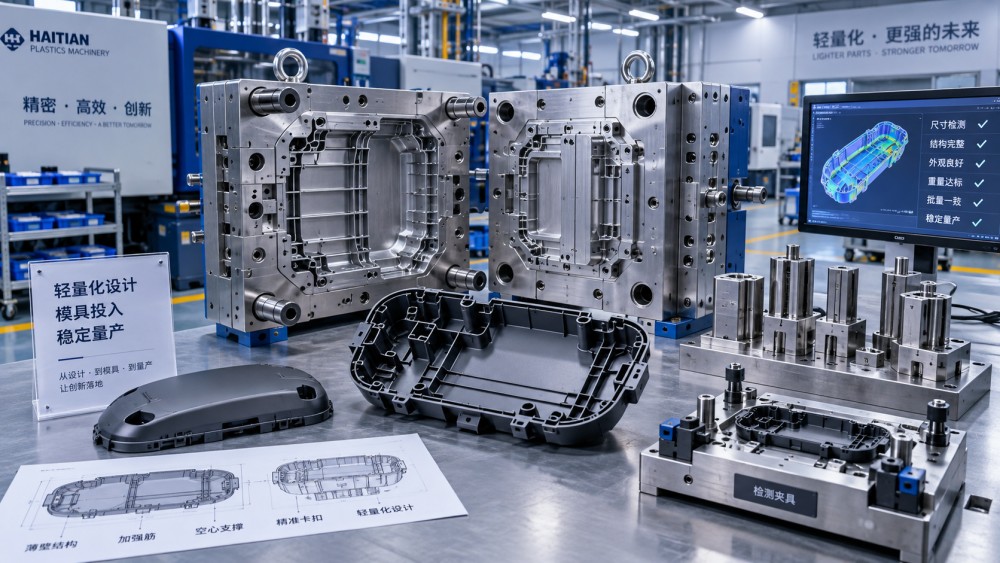
Thin walls can hide different failure mechanisms
Two lightweight parts may show the same visible defect, such as a distorted edge or unstable fit, while requiring completely different corrections. A molded part that bows after ejection may be affected by differential cooling, nonuniform shrinkage around glass-filled regions, premature ejection, or an overly flexible design. Adding packing pressure can improve one condition and worsen another by increasing frozen-in stress. The source must be identified before modifying the tool.
Likewise, a cast section that fails near a joint may be too thin for the applied load, but it may also contain porosity near a fastener location or have a grain structure affected by local cooling. Making the nominal wall thicker near the failure point may help, yet moving the gate, revising the overflow layout, or changing the joining method could be the more effective intervention.
Material substitution introduces its own traps. Fiber reinforcement can raise stiffness and permit a thinner molded wall, but it may increase anisotropic shrinkage, tool wear, and sensitivity to fiber orientation. A recycled-content formulation can reduce dependence on virgin feedstock, but its property window, contamination control, moisture condition, and batch consistency need to match the component's structural demands. Lightweighting based on a laboratory coupon value, without accounting for actual flow direction and weld lines, is a common route to unexpected performance variation.
A comparison of common tooling paths
The volume question is often asked too simply
Higher volume improves the ability to recover tooling cost, but volume alone does not establish a sound case. A long-running program with frequent design changes can make hard tooling unattractive even at considerable output. A stable part with modest annual demand may justify tooling if it replaces a labor-intensive fabricated assembly or if the existing process has poor repeatability. The relevant measure is the expected number of conforming parts over the tool's useful life, adjusted for ramp-up yield, planned variants, maintenance stops, and the likelihood of engineering changes.
Cycle time deserves the same scrutiny. Lightweight geometry can cool faster, but a more complex tool may add slides, lifters, inserts, conformal cooling requirements, or automated handling steps. A calculated saving based on thinner walls can disappear when the mold must remain closed longer to control warp, or when a robot waits for a delicate part to become rigid enough for extraction. Tooling capacity must be considered as a system: machine availability, mold cooling, drying capacity, inspection pace, and post-processing all affect the output that pays back the investment.
There is also a difference between a low piece weight and a low material footprint. A lightweight multi-material part may be difficult to separate at end of life. A part that combines metal inserts, adhesives, coatings, and incompatible polymers can solve an immediate structural problem while complicating recovery. Where circularity matters, the design should account for disassembly, material identification, regrind tolerance, and whether recycled feedstock can re-enter the process without undermining performance.
Use functional targets before selecting a process
Starting with a target percentage of weight reduction tends to distort the design discussion. Better targets describe what the component must do: support a defined load without excessive deflection, maintain a sealing surface, survive a drop or vibration condition, tolerate thermal cycling, meet appearance needs, and fit its mating parts after molding or casting variation. The mass target then becomes a constraint to optimize, rather than the only measure of success.
This approach also prevents a frequent assembly error. A light individual component can transfer stress into its mounting points. If the mounting structure must be thickened, reinforced, or fitted with additional hardware, system weight may rise even though the redesigned part weighs less. Reviewing the load path across the assembly exposes these trade-offs early, when geometric changes are still inexpensive.
Toolmakers, material specialists, product designers, and quality engineers need the same functional assumptions before steel is cut. A drawing that lists only nominal dimensions and a generic material name leaves too much unresolved. Gate-sensitive surfaces, critical flatness zones, cosmetic faces, allowable knit lines, fastening locations, and recycled-content constraints should be identified during design release. This does not eliminate development work, but it concentrates it before changes become tool modifications.
When a lower-cost pilot is appropriate
Soft tooling, prototype molds, interchangeable inserts, or limited-cavity tools can be useful when the uncertainty lies in the part's behavior rather than its visual form. They allow evaluation of filling, shrinkage, ejection, structural performance, and assembly fit using a process closer to production than additive prototypes alone can provide. Their role is not to predict every aspect of long-term production. Tool wear, cavity balance, automation repeatability, and sustained thermal stability may only emerge in the production-intent system.
A pilot should answer specific unresolved questions. For example, whether a ribbed geometry fills before the gate freezes, whether a recycled blend remains stable after multiple processing cycles, or whether a thin section stays flat after exposure to the intended environment. Using pilot tooling merely to obtain samples without defining those questions can delay the same uncertainty until the expensive tool is already committed.
The practical decision threshold
Lightweight manufacturing earns the tooling cost when the redesign creates a repeatable operating window and the lifetime gains are attached to the whole product system. Those gains may come from reduced material use, fewer components, lower motion loads, shorter cycle time, more efficient transport, or a cleaner recovery route. They should be tested against the added costs of development, scrap exposure, maintenance, inspection, automation, and future design inflexibility.
If the lightweight concept depends on narrow processing limits, difficult material control, or structural margins that disappear under ordinary variation, the apparent mass saving is fragile. If the concept uses geometry, material selection, and tooling design to create stable output at the planned scale, the higher initial investment becomes a production asset rather than a sunk cost.
Related News
- 00
0000-00
How to Compare Control System Platforms for Integration, Lifecycle Cost, and Support - 00
0000-00
Root-Cause Analysis of Precision Molding Defects: From Flash to Dimensional Drift - 00
0000-00
CE Marking for Automated Grippers: Safety Requirements and Technical File Essentials - 00
0000-00
How to Evaluate a Material Forming Equipment Factory Before Placing an Order - 00
0000-00
How to Specify Cleanroom Equipment for Semiconductor Manufacturing Lines
Weekly Insights
Stay ahead with our curated technology reports delivered every Monday.