
Commercial Insights




Comparing molding machinery suppliers for global compliance is not a matter of collecting certificates and selecting the lowest-priced machine. The practical question is whether a supplier can deliver equipment, documentation, controls, and support that remain acceptable in every market where the machine will be installed, operated, serviced, or used to make regulated products.
A machine can be technically capable and still create expensive delays if its safety design, electrical components, operating records, material traceability, or local service arrangement do not fit the destination market. Buyers should therefore compare suppliers against the intended production system, not against a generic specification sheet.
Start with the markets and applications, not the supplier brochure
Before requesting quotations, define where the equipment will be shipped, what it will produce, which materials it will process, and how it will connect with upstream and downstream equipment. Compliance expectations can differ substantially between an injection molding cell producing consumer packaging, a die-casting line for vehicle components, and an extrusion system handling recycled polymer.
Make a short project brief that includes the destination country or countries, product category, material types, expected automation level, site utilities, operator access, and any customer-specific requirements. This brief gives every supplier the same basis for quotation and makes gaps easier to spot.
Do not assume that a supplier’s statement that a machine is “export ready” means it is ready for your project. Ask what configuration that statement applies to. A standard machine sold internationally may still need changes to guarding, electrical architecture, control language, documentation, labeling, or operator interfaces before it is suitable for a particular site.
Compare compliance as a deliverable, not a claim
When asking, “How do I compare molding machinery suppliers for global compliance?”, begin with evidence. A credible supplier should be able to explain how compliance is built into the machine and what documentation accompanies the shipment. Broad declarations without a machine-specific document package are weak evidence, especially for a complex automated cell.
Ask each supplier to identify the boundary of responsibility in writing. This is especially important where one company supplies the molding machine while another supplies automation, temperature control, material handling, or inspection equipment. The buyer should know who validates the combined cell, who supplies the final documentation, and who resolves an interface problem during commissioning.
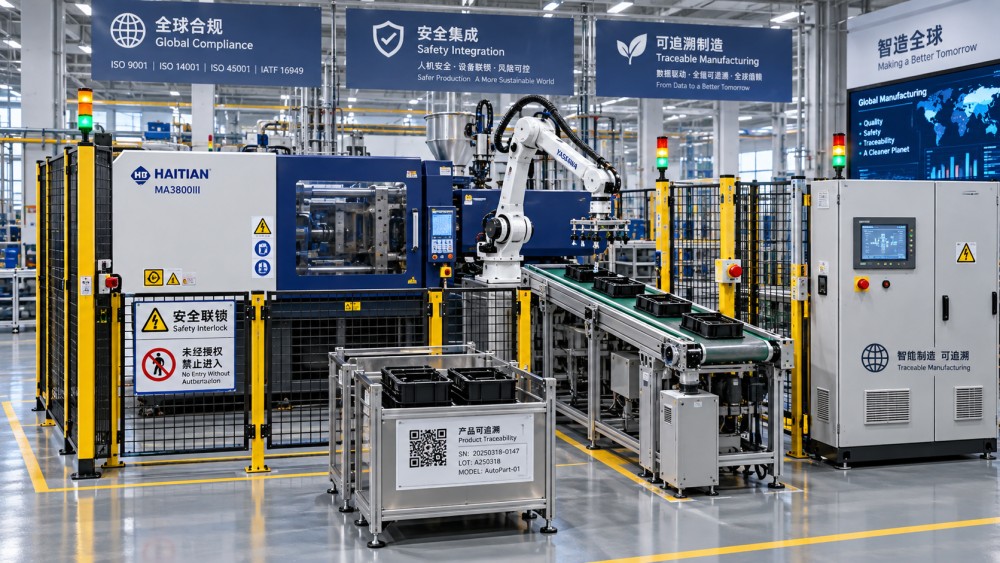
Safety design matters more than a long certificate list
Certificates matter, but a buyer should look beyond the logos. Safety quality is visible in the details: whether guard doors are practical for normal maintenance, whether the operator can safely clear a jam, whether a robot recovery procedure is controlled, whether access to hot zones is considered, and whether emergency-stop behavior is understood across connected equipment.
For injection molding and extrusion, the operating reality includes hot surfaces, moving platens or pullers, pressure, material leakage, and maintenance around heaters and hydraulic or electric systems. In die-casting, thermal exposure, molten material, lubrication, and large moving equipment add further complexity. The supplier should be able to discuss these hazards in relation to the proposed machine, rather than providing only a generic safety statement.
A useful comparison method is to request a live or recorded walkthrough of the proposed configuration. Ask the supplier to show normal operation, mold or die change access, fault recovery, cleaning, and maintenance isolation points. This often reveals more than a checklist because it shows whether safety has been integrated into the working process or added around it.
Examine the documentation package before placing the order
Documentation is frequently treated as an administrative issue until the machine reaches the plant. At that point, missing circuit diagrams, unclear pneumatic layouts, incomplete software backup procedures, or untranslatable manuals can slow commissioning and make future repairs dependent on the original supplier.
Compare the proposed documentation package line by line. It should be specific enough to support installation, operator training, planned maintenance, fault diagnosis, spare-parts ordering, and safe modification. For an automated molding cell, documentation should also make clear how the machine and peripheral equipment communicate and how safety signals are exchanged.
Language deserves attention. A manual that is technically complete but unusable by maintenance personnel does not solve the operational problem. Clarify the languages required for operating instructions, warning labels, electrical documents, human-machine interface screens, and training materials early in the procurement process.
Test automation compatibility at the cell level
Automation can improve repeatability, reduce manual handling, and support traceability, but it can also make compliance ownership unclear. A molding press may be properly designed on its own, while the complete line becomes difficult to validate once robots, feeders, granulators, conveyors, cameras, or packaging stations are integrated.
Compare suppliers on their ability to define interfaces. They should state which signals are exchanged, which party controls start and stop logic, how protective devices are monitored, what happens after a safety stop, and how production data is captured. The more suppliers involved, the more valuable a clear system integrator role becomes.
Buyers planning to process recycled feedstock should also look at the control system’s ability to handle material variability. Recycled materials can have wider variation in moisture, contamination, melt behavior, or batch consistency than tightly controlled virgin feedstock. That does not make them unsuitable for molding, but it increases the value of stable process monitoring, material identification, alarm handling, and documented parameter management.
Energy and circularity claims need an operating context
Energy efficiency is a reasonable comparison factor, particularly for equipment expected to run long production cycles. However, comparing a single headline consumption figure is rarely enough. Energy use changes with part geometry, cycle time, clamp force, barrel or melt requirements, heating and cooling setup, material condition, automation load, and actual operating discipline.
Ask suppliers how they measure or estimate energy performance for the quoted configuration and what assumptions are used. Request information on machine modes, heating control, drive architecture, insulation, cooling requirements, and energy monitoring options. A supplier that can show how production settings affect consumption is more useful than one that offers a broad efficiency claim.
The same principle applies to circular manufacturing features. A system designed to support regrind, recycled resin, scrap separation, or closed-loop handling needs more than a material-feeding option. The buyer should assess contamination control, lot separation, process stability, purge handling, quality checks, and the ability to trace material movement. Circularity is credible when the process can manage variation without obscuring quality accountability.
Use factory acceptance testing to compare capability under realistic conditions
A factory acceptance test should not be limited to confirming that the machine turns on and completes a cycle. It is the best opportunity to test whether the promised configuration works with the intended mold, die, material, automation sequence, and data requirements.
Agree on the acceptance criteria before manufacturing is complete. Depending on the project, this may include cycle stability, safety-device behavior, alarm handling, process repeatability, robot communication, data export, operating modes, and documentation delivery. Where production quality is sensitive, define how process parameters will be recorded and what evidence will be supplied with the equipment.
Buyers should be cautious when suppliers resist defining acceptance criteria or defer all questions to site commissioning. Some adjustment at the plant is normal, but the basic mechanical, safety, control, and interface obligations should not remain ambiguous until after shipment.
Compare the supplier’s support model, not only its local sales presence
Global support is more than having a distributor in the region. Find out who performs installation, whether technicians understand the supplied control platform, how spare parts are identified, whether remote diagnostics are available, and how software access is managed. A long-lived molding machine will need maintenance, troubleshooting, upgrades, and potentially new molds or peripheral equipment.
Also ask about ownership of control software, parameter backups, and service access. A buyer does not need unrestricted access to every protected function, but operations should not be left unable to recover from a routine controller or communication issue because essential files or credentials are unavailable.
For projects crossing several markets, independent market and technology intelligence can help buyers frame these questions before the request-for-quotation stage. GMM-Matrix focuses on injection molding, die-casting, extrusion, and molding automation, including process trends around recycled material processing, equipment connectivity, and industrial decarbonization. That context is useful when comparing a supplier’s proposal against the practical demands of the intended process rather than against marketing language alone.
A practical supplier comparison sequence
- Define the target markets, application, materials, production cell, and local installation conditions.
- Issue one technical and compliance brief to every shortlisted supplier.
- Score proposals separately for machine capability, compliance evidence, documentation, automation integration, lifecycle support, and commercial terms.
- Review safety and control interfaces with engineering, maintenance, production, quality, and site safety personnel before selecting a supplier.
- Write documentation, training, software backup, acceptance testing, and commissioning responsibilities into the purchase agreement.
- Retain the final technical file and test records in a format that can be used by the plant after handover.
The common mistake is allowing price, tonnage, cycle-time claims, or delivery promises to dominate the decision. Those factors matter, but they do not replace a supplier’s ability to deliver a maintainable, documented, safely integrated system for the markets you serve. The stronger supplier is usually the one that answers detailed compliance questions clearly, assigns ownership at the cell boundary, and can support the machine after it enters production.
Related News
- 00
0000-00
What Drives Material Shaping Technology Cost in High-Volume Manufacturing? - 00
0000-00
ISO Compliance for Precision Molded Components: What Quality Teams Must Verify - 00
0000-00
What Drives Precision Material Shaping Cost in High-Volume Production Projects? - 00
0000-00
How Should Buyers Compare Molding Machinery Suppliers for Global Compliance? - 00
0000-00
Is a Recycling Machine Worth It for In-House Plastic Scrap?
Weekly Insights
Stay ahead with our curated technology reports delivered every Monday.